
Issue #491 – Wednesday, June 17, 2026
Can You See the Forest
Part2
by Amy Alpers
In Part 1 of this article we discussed what “seeing the forest for the trees” means in terms of teaching Pilates. It means remembering the larger key point of the Pilates method according to Mr. Pilates himself – Uniform Development, – and not getting too distracted from this greater intention by all the tons of rules and regulations we’ve been taught. If those rules and data don’t truly serve the big picture – uniform development of the individual, – then potentially that hard and fast rule is up for re-evaluation.
We then took a deeper dive into one part of the body, the lower leg, and the need for its essential proper alignment over the talus of the foot as an integral and foundational part of whole body uniform development.
Try this imagery exercise to explore this alignment idea. Stand up in your normal relaxed way without “fixing” anything. Now, feel your habitual posture – what muscles are doing what to hold you up? How are your bones stacking and floating above each other, or not? Feel how and where your weight falls into your feet, shins, quads, back, etc.
Next, release all your muscles a bit and let your ankles, knees and hips bend slightly to neutralize and free you from any patterns for a second. Now, imagine the weight in your feet having to rise up through your talus and ankles straight up into your shin/tibia perfectly vertically. I often add this thought – imagine a wall with wet paint behind your calves and don’t touch it. In other words, use your calf muscle to hold your tib/fib directly up over the talus perpendicular to the floor v. push or drop your calf backwards into the paint. To straighten your knee next, picture where the calf/gastroc muscle attaches at the back of your heel and the bottom of the back of your femur above the knee (see Part 1 for image), and initiate straightening the knee by first subtly pulling the femur backwards over the top of your tibia. Don’t touch the wet paint with your calves!! This will then enable your quadriceps to more naturally and effectively pull your kneecap and femur straight up from the top of the shin to your pelvis/abdominals/psoas.
This is how you arrive at your maximum height without stretching or reaching – by aligning and stacking your leg bones correctly and then reminding all the muscles what they’re truly designed to be doing – holding you upright. Now you can readily align the rest of your body above this straight leg line, and breathe more freely and “capaciously”, bend your spine in any direction, and feel your blood, lymph and nervous system pulsing and flowing without constriction. These are all the natural results of a uniformly developed body, as Mr. Pilates intended.
If you establish the clarity and strength of this foot and leg alignment right from the start of you or your client’s Pilates journey, you will automatically build upon this solid foundation and will “never have anything to ‘unlearn’.” [JHP RtoL]
It’s one thing of course to do this in upright standing alignment, but a lot of Pilates exercises are done supine. Let’s consider Footwork on the Reformer. This can be the moment we initiate our Pilates future well, or, conversely, develop poor habits that will need to be unlearned.
Lying supine with your body and head supported and the balls of your feet on the foot bar (first Footwork position) allows your spine to relax and feel supported, aligned and ready to move. This is why Mr. Pilates starts us there. Even the organs can fall back in gravity and thus help the abdominals do a better job. However, nothing between your toes and your hip joints is supported and therefore, the knee and leg is free to choose a number of possibilities. Most commonly to lock, drop or hang in gravity as you “straighten” your knees.
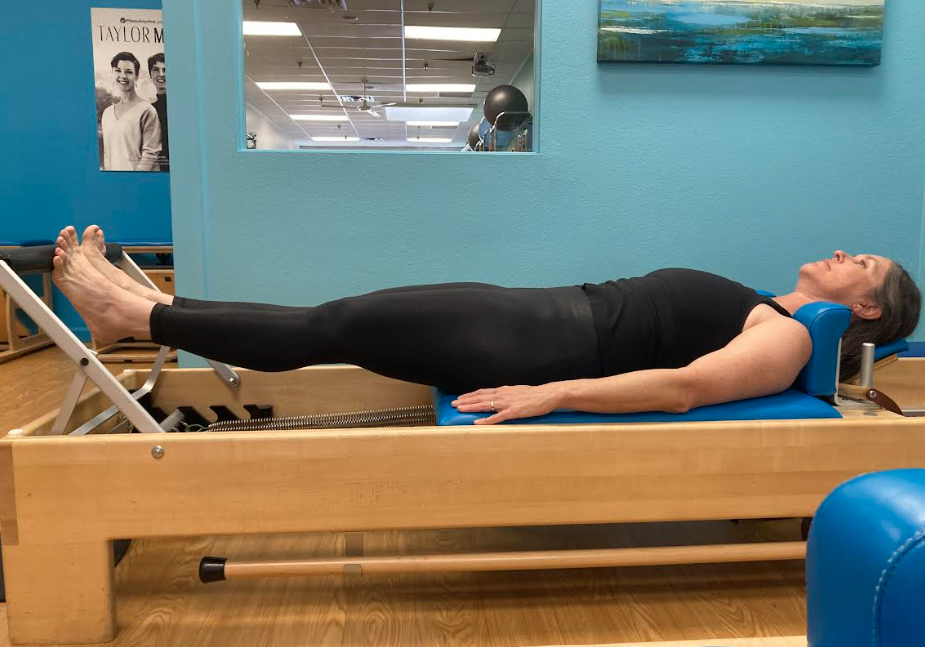
To prevent this and build the proper alignment and strength through your whole leg for when you are standing (all exercises in Pilates should be creating the same ideal alignment and strength needed for upright standing), you perform the same process as you did above in the imagery exercise. The foot muscles need to hold up the arches and heels so that the muscles that rise up from the bottom of your foot can come directly through the talus and up your tibia and fibula correctly and support your shin in space successfully all the way to the back of the knee at the bottom of the femur. This then enables your quads to then truly “straighten” your knee by pulling your kneecap directly up to your femur to your pelvis in a straight line horizontal line from your talus to your pelvis. No dips, bows, dropping or hanging the leg off the hip or the footbar. All bones supported in alignment even “out” of gravity.
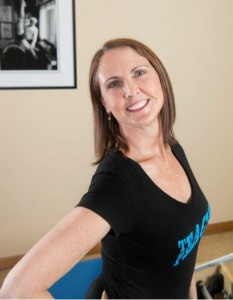
Amy Taylor Alpers co-founded The Pilates Center (TPC) and The Pilates Center Teacher Training Program (TPCTTP) over 20 years ago in Boulder, Colorado. When not traveling the world to teach both foundational and graduate level Pilates teacher education she remains part of the core faculty for TPCTTP, mentors advanced teachers, teaches classes and sees clients. In addition to teaching TPC sponsored workshops, Amy has presented numerous times at the Pilates Method Alliance Annual Meeting, Balanced Body’s Pilates on Tour and Passing the Torch. In 2013, Amy presented at the Shared Traditions Conference for Fletcher Pilates and will present at The Pilates Roundtable.
Amy was born in Youngstown, Ohio where she began classical ballet at age two.
She attended The Juilliard School for Dance, danced with the Garden State Ballet in New Jersey, and received a B.A. in Dance and a M.A. in Dance History from New York University. In addition, Amy taught ballet at various dance schools in New York City for ten years before launching her Pilates career.
Both Amy and her sister Rachel studied Pilates under the direct tutelage of Romana Kryzanowska at the original Pilates Studio in New York City. They received their Pilates teaching certificate from there in July of 1989. In 1990, after moving to Boulder, Colorado, Amy and Rachel founded The Pilates Center. The sisters then created and established The Pilates Center Teacher Training Program in 1991. The school has since expanded to include an Intermediate Program, Advanced Program, Bridge Program, Master’s Program, and a Mentorship Program. In addition, TPC now has “Licensed” and “Host” studios established all around the world.
Amy and her sister wrote The Everything Pilates Book, published in 2002. She was a founding board member of the PMA and sat on the board that created the PMA Certification Exam. Recently she has also had the honor of filming classes and workshops for online organizations such as Pilates Anytime and Pilates On Demand.
In 2011, Amy, her sister Rachel, and Ken Endelman of Balanced Body, developed CenterLine – a line of equipment designed for classical Pilates and based upon the specifications pioneered by Joseph Pilates.