
Issue #490 – Wednesday, June 10, 2026
Can You See the Forest
Part 1
by Amy Alpers
“To see the forest through the trees” means we are able to recognize, “see” the larger, overall situation or “big picture” (the forest) rather than get lost in the small, minor details (the trees). It requires that we step back a bit to grasp the entire context, rather than being blinded or distracted by all the more detailed, specific, immediate, or minor elements. In Pilates this often looks like getting bogged down in the rules, data, and information, – the “what” and “how to’s” – and, consequently, no longer truly being able to stay committed to the whole point – the actual overall mission or intention of the system. What did Joseph Pilates fundamentally design his method to achieve in the human?
He was actually quite clear about this. He states – “[Contrology] …is the attainment and maintenance of a uniformly developed body …” What is a uniformly developed body? Can you see that forest through all the distracting trees to better understand how to utilize and apply all the rules and information in Pilates so that you actually help enable your client to achieve a uniformly developed body?
To me, the concept of uniform development has been my primary guiding light through my three and a half decades of teaching Pilates. I could probably write a dozen or more articles or teach equally that many workshops exploring this concept with varying thematic ideas or parts of the body. Here I will focus on one very user friendly and hopefully foundational way of viewing the intention of the entire Pilates method through one larger concept.
Alignment! I think most if not all of us agree that alignment of the musculoskeletal human body is essential to health and one of the key goals of the Pilates system. But what does it really mean? One day I was simply sitting quietly and observing the life-size human skeleton hanging in our studio, and I had a major realization. The entire human body – the head/brain, spine, ribs, shoulder girdle, and arms, all the organs and contents of the torso, the pelvis and legs – must ALL balance in a perfect suspended harmonious tensegrity of muscles and connective tissue supporting the skeleton in its ideal upright alignment, above and directly over the talus bone. All of it – over that one small bone.
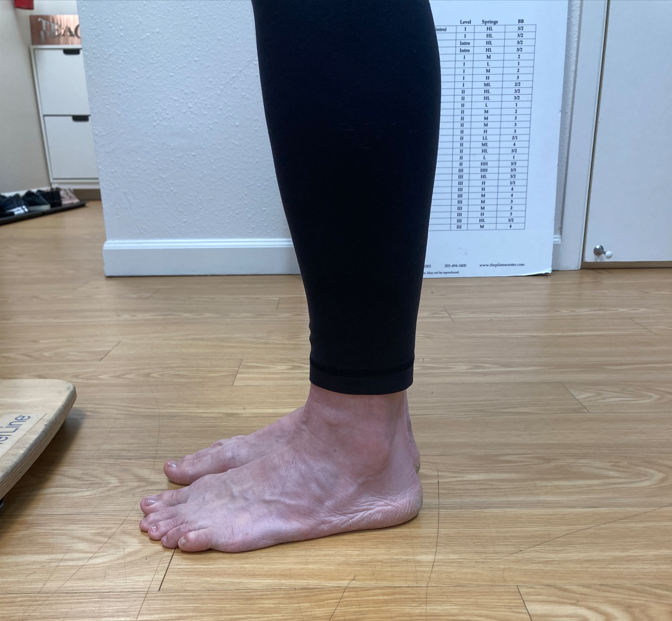
The Talus bone is the one directly under the tibia and fibula on the top of the foot. All of the weight of absolutely everything in the whole human body above that point must ultimately funnel perfectly through the talus and then distribute through the amazing suspension arches of the feet. Conversely, coming from the ground up instead, the entire body must rise from the arches of the feet, through the tiny channel of the talus bone to continue straight upward into its full magnificence. What a perfect, simple and foundationally primal truth.
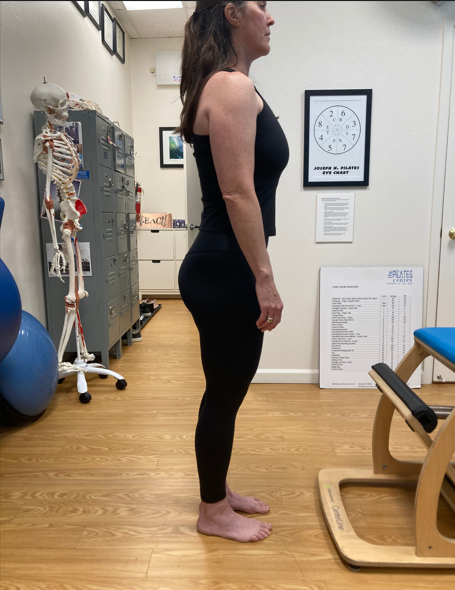
Does it, however? Does the whole body balance beautifully over that small ball bearing like bone in the ankle?
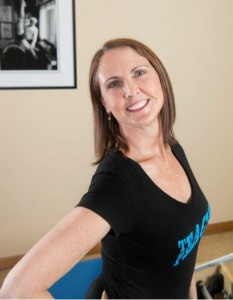
Amy Taylor Alpers co-founded The Pilates Center (TPC) and The Pilates Center Teacher Training Program (TPCTTP) over 20 years ago in Boulder, Colorado. When not traveling the world to teach both foundational and graduate level Pilates teacher education she remains part of the core faculty for TPCTTP, mentors advanced teachers, teaches classes and sees clients. In addition to teaching TPC sponsored workshops, Amy has presented numerous times at the Pilates Method Alliance Annual Meeting, Balanced Body’s Pilates on Tour and Passing the Torch. In 2013, Amy presented at the Shared Traditions Conference for Fletcher Pilates and will present at The Pilates Roundtable.
Amy was born in Youngstown, Ohio where she began classical ballet at age two.
She attended The Juilliard School for Dance, danced with the Garden State Ballet in New Jersey, and received a B.A. in Dance and a M.A. in Dance History from New York University. In addition, Amy taught ballet at various dance schools in New York City for ten years before launching her Pilates career.
Both Amy and her sister Rachel studied Pilates under the direct tutelage of Romana Kryzanowska at the original Pilates Studio in New York City. They received their Pilates teaching certificate from there in July of 1989. In 1990, after moving to Boulder, Colorado, Amy and Rachel founded The Pilates Center. The sisters then created and established The Pilates Center Teacher Training Program in 1991. The school has since expanded to include an Intermediate Program, Advanced Program, Bridge Program, Master’s Program, and a Mentorship Program. In addition, TPC now has “Licensed” and “Host” studios established all around the world.
Amy and her sister wrote The Everything Pilates Book, published in 2002. She was a founding board member of the PMA and sat on the board that created the PMA Certification Exam. Recently she has also had the honor of filming classes and workshops for online organizations such as Pilates Anytime and Pilates On Demand.
In 2011, Amy, her sister Rachel, and Ken Endelman of Balanced Body, developed CenterLine – a line of equipment designed for classical Pilates and based upon the specifications pioneered by Joseph Pilates.