
Issue #476 – Wednesday, December 3, 2025
Taking a Look at the Boomerang
by Tricia Whitlock
One of the reasons I enjoy writing for Pilates Intel is because it gives me a reason to look ever closer at the Pilates method – its logic, its depth, and the way each exercise reveals something new when examined with attention. Each article becomes an invitation to look more deeply into the Pilates system, sharpening my own understanding while hopefully offering something valuable to this community of readers. In today’s article, we’ll take a close look at an advanced exercise in classical mat – Boomerang.
Boomerang is a playful yet demanding movement that appears in the advanced repertoire, nestled between Snake/Twist and Seal. True to its name, the boomerang carries the qualities of vigor, fluidity, and precise control. It asks the body to seamlessly transition between strength and suppleness, and rewards the mover with a sense of integration that can feel almost dance-like.
Inquiring minds want to know – do you avoid the boomerang, or do you love it?
Years ago I trained twice a week for a full year with a Romana’s teacher-in-training. She was already a gifted teacher, and pushed me to new personal limits. At the time, I was still relatively new to Pilates and stubbornly avoided exercises challenged my body in unfamilar ways. Boomerang was one of them.
So let’s begin at the beginning: What exactly is a boomerang, and why did Joe Pilates name an exercise after it? Merriam-Webster defines a boomerang as “a bent or angular throwing club typically flat on one side and rounded on the other so that it soars or curves in flight, especially one designed to return near the thrower”. Traditionally made from wood that is both light and strong, the boomerang’s distinctive shape is unmistakable. If you place an image of a boomerang beside someone performing the exercise, the visual connection becomes clearer.
Boomerang requires that you’ve already achieved mastery of several exercises: the Rollup, Rolling back, and the Rollover.
As with all Pilates work, breath, control, and precision are essential to executing this exercise well. In my own practice, I eventually found a rhythm in Boomerang that feels uniquely satisfying – a blend of flow, strength, and timing that made the effort worthwhile.
Through knowledge gained in continuing education courses, I learned that Boomerang was taught differently by Joe and Romana. In this article, we will explore both ways.
Breakdown of Joe’s boomerang
Joe’s boomerang is a combination of the Rollover, Rowing (on the reformer), Crab, and Backward Arms. Perhaps there are other exercises within the boomerang that you can see or feel!
Joe’s “Return to Life through Contrology” states to do the exercise 6 times. Let’s look at the steps to execute Joe’s Boomerang as outlined by Joe:
- Take position illustrated. INHALE SLOWLY. Sit up straight in right angle position. Head up. Abdomen drawn in. Cross left leg over right leg. Arms pressed against body. Hands pointed forward and pressed against mat or floor.
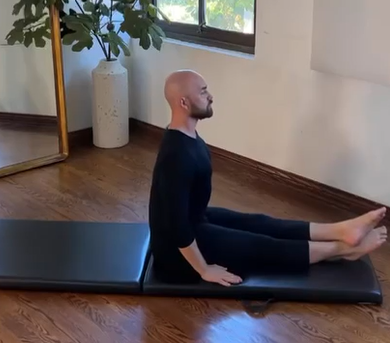
- EXHALE SLOWLY while “rolling” backward as far as possible while in this position. Cross right leg over left leg.
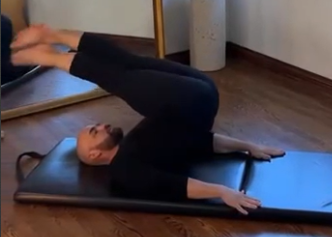
- INHALE SLOWLY while “rolling” forward and “swing” arms backward as far as possible.
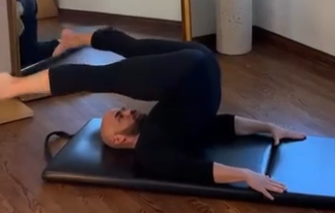
- EXHALE SLOWLY while bringing both legs to mat or floor with head touching knees, with arms (palms up) raised backward as far as possible and upward. Return to Pose 2 position.
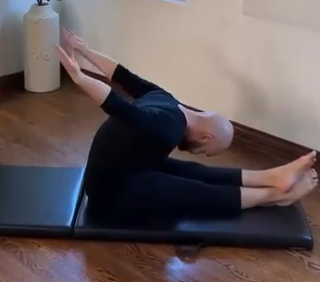
Breakdown of Romana’s boomerang
Romana’s boomerang is a combination of the Rollover, Rollup, Rowing (on the reformer), and Teaser. 3-5 repetitions are suggested. I was unable to find a reason for the variance.
Now, let’s look at the steps to execute Romana’s boomerang (my interpretation):
- Sit rounded over legs that are stretched forward, pressing your palms firmly into the mat or floor. Lift one leg up and cross it over the other.
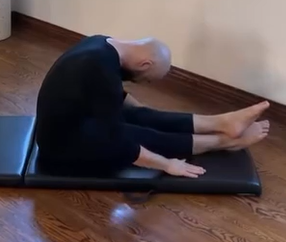
- Roll back to the mat in this shape as you inhale, bringing your legs overhead and parallel to the floor behind you and pressing your arms into the mat.
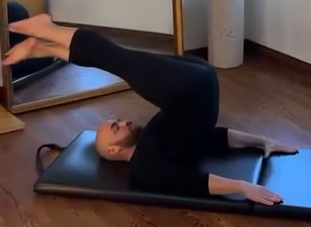
- Open your legs shoulder distance and switch them, crossing the opposite leg on top.
- Roll up into a teaser as you exhale, reaching for your feet, pulling back strongly in your center to create opposition.
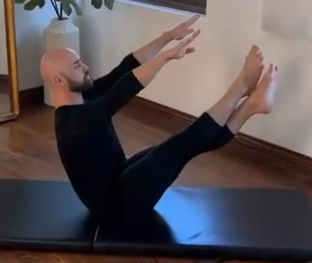
- Bend your elbows and bring your arms behind you as you inhale, interlace your fingers and lower your legs to the mat as you lift your arms high towards the ceiling, bringing your head to your knees.
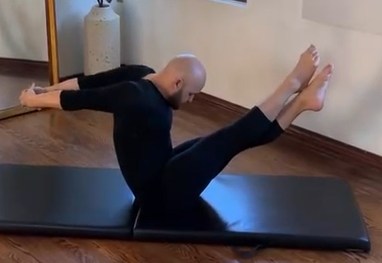
- Bring your legs to the floor and circle your arms overhead and around. Reach for your ankles as you exhale into a deep stretch.
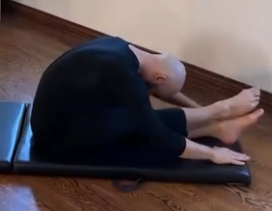
Check out a video of both versions here!!
Photo and video credits go to Chaz Knight of chazknightpilates
I find the differences between Joe’s and Romana’s instructions especially interesting, especially the breath. Romana’s version feels much more complex, and I rarely introduce it to students until they have fully mastered Joe’s version, or sometimes not at all. Looking back, that very complexity is likely why I resisted learning it in the beginning.
Over the years, I’ve seen subtle variations in the exercise and learned alternative ways of approaching and cueing boomerang in workshops and from other teachers. Some of these stay in my back pocket, while others fall away. Every student responds differently, so having a range of approaches can be invaluable.
How and when to teach the Boomerang
Now that we know what the Boomerang is, the next question is when to offer it to a student. As with any Pilates exercise, knowing it deeply in your own body is essential to teaching it with confidence and clarity.
Reaching the arms around and behind the body requires healthy shoulders with excellent mobility, as well as the ability to connect the arms to the back. Observing ease and competency of other mat exercises – such as the Rollup, Neck pull, Rolling back, and Seal will help you determine when a student is for Boomerang. If your student also works on the reformer, exercises like the Rowing series, Stomach massage (round and flat), and Tendon Stretch are strong indicators of readiness.
Boomerang is fun, challenging, and undeniably demanding. Like the rest of the Contrology repertoire, it calls for complete coordination of body and mind – strength, suppleness, timing, and awareness woven together into a single, seamless flow.
So now that you know a bit more about this classical gem, will you bring Boomerang into your own practice and teaching – if you haven’t already?
Tricia Whitlock is the owner of Soul Body Works, a home Pilates studio in north Texas. She began her Pilates journey at the age of 41 after having worked in corporate America for her entire adult life, transitioning into the world of health and fitness after the untimely death of her mother changed her perspective on life. Discovering Pilates changed Tricia’s life in many ways – not only did it provide the fuel for her entrepreneurial spirit, it healed her body from many years of chronic infections, sciatica and lower back pain, as well as giving her the fluid, graceful ability to move that she had always desired. Tricia owned and managed a busy studio from 2014-2023, and then happily transitioned into a busy and fun home studio setting, where she is able to devote more time to study, gardening, creating art, traveling, and animal rescue.
When she’s not teaching, Tricia is busy running her Facebook group Traveling Pilates Instructors, a group of nearly 19,000 Pilates instructors and studio owners with the shared desire to travel and teach Pilates. If you’re not on Facebook, you can sign up for Tricia’s mailing list here: https://plain-band-67132.myflodesk.com/mcsxl70vvj.