
Issue #460 – Wednesday, May 14, 2025
Tips and Techniques for Mastering the Pilates Push Up
Part 1
by Cathy Pagani
Push Ups are challenging. They require not only strength, control, and stability, but coordination and balance as well. They ask us to engage the entire body, from our toes to our head. Both upper and lower body are equally active with the Powerhouse serving as a control center. Our shoulders, back, neck, chest, biceps and triceps need to be strong, our abdominals and gluteals must be engaged, and our wrists and ankles need to be flexible. It’s no coincidence that Push Up falls at the end of the classical mat sequence: we have to be fully warmed up and completely focused to do Push Up well. It is an exercise that improves our core stability; strengthens a range of muscles, including the lower back, chest, arms and shoulders; helps us maintain good posture; and provides a sense of well-being. With all that it offers, could Push Up be the perfect Pilates exercise?
Given its complexity, there is something uniquely satisfying in performing a proper Pilates Push Up. Getting there requires patience and a thoughtful approach to building strength and developing technique. Many of us find Push Up intimidating and don’t know where or how to begin. We muddle through by doing Push Up on our knees, our heads drooping and backs sagging, hoping that eventually we will build up the strength for a full-plank Push Up if we just keep trying. It is a common, though not very efficient, approach.
This article offers some thoughts on how to develop competency in executing Push Up. The journey to a strong Push Up requires us to progress incrementally: we do not advance to the next level until our strength, technique, and flexibility allow it.
The Push Up, According to Mr. Pilates
What, exactly, is a Pilates Push Up? Joseph Pilates’ 1945 publication, Return to Life, gives us insight into his thoughts on how to perform Push Up. He has us start by standing in a forward fold with our hands on the mat. We walk on the palms of our hands until we reach a plank position. The body, in Mr. Pilates’ words, is “rigid and in a straight line from head to heels.” We are on our toes, with our arms shoulder-wide, the upper arms tucked against the body, and our fingers pointing forward. Keeping the body “rigid,” the back “locked,” and the upper arms “pressed firmly to the body,” we inhale as we lower ourselves down until our chin touches the mat or the floor. He instructs us to keep our hips “locked,” our abdomen “‘drawn’ in,” and the “chest raised above the mat or floor.” We exhale to raise the body slowly to the starting position. He cautions us to “keep shoulders in straight line with hands. … Head in straight line with body. Keep body absolutely rigid. Move arms only (not body). Touch chin (not chest) to mat or floor.”
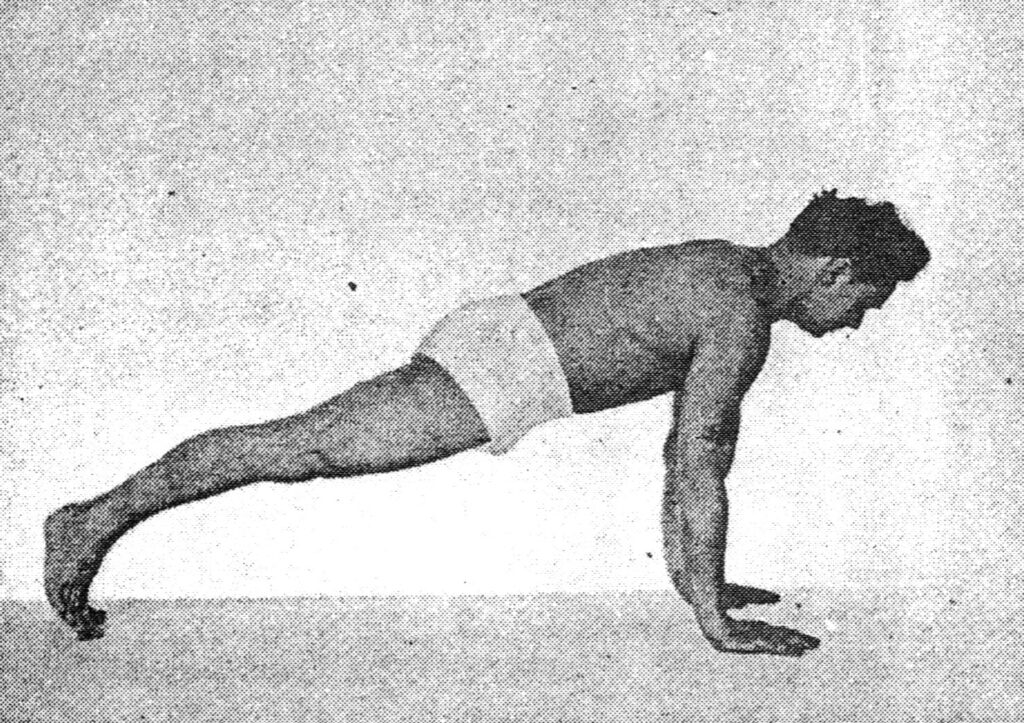
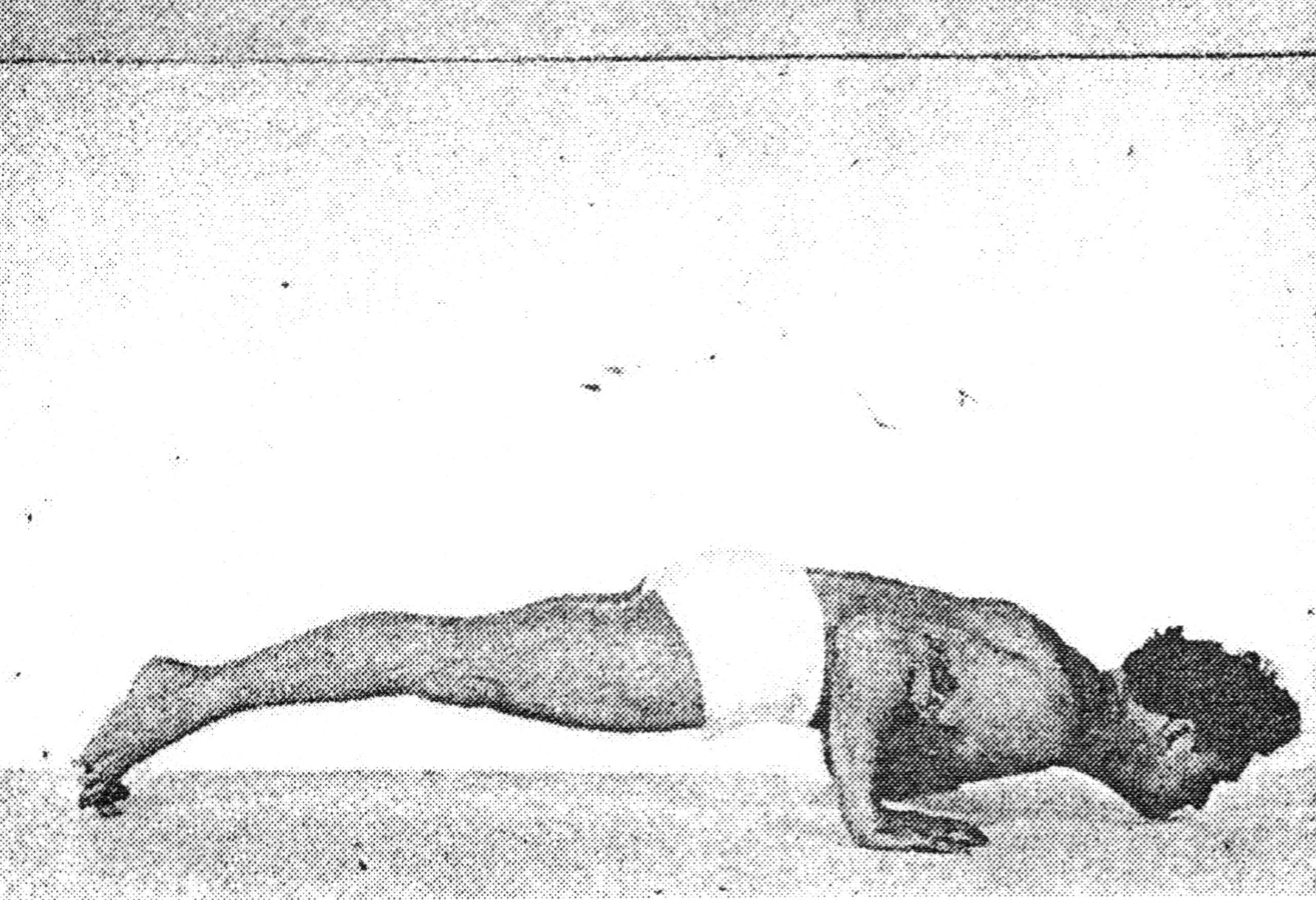
Photos of Joe Pilates from his book “Return to Life”
Using terms like “locked” and “rigid,” Mr. Pilates paints a picture of a powerful exercise that requires absolute control over the entire body. It is an aspirational exercise: don’t we all want to be able to perform Push Up just as Mr. Pilates described it in Return to Life and demonstrated in the accompanying photographs? As difficult as it sounds to perform, Push Up is within our grasp provided we approach our training with a well-considered and comprehensive plan.
Building a Better Push Up
Effective training for Push Up requires a holistic approach. Here, acquiring specific movement awareness, building strength and refining technique, and developing and maintaining wrist and ankle flexibility work in concert with one another. They are like the legs of a three-legged stool: if one component is missing or weak, the stool collapses. Thus, each part needs to be practiced equally and consistently. Let’s take a quick look at each of these components.
1. Getting a Feel for Push Up
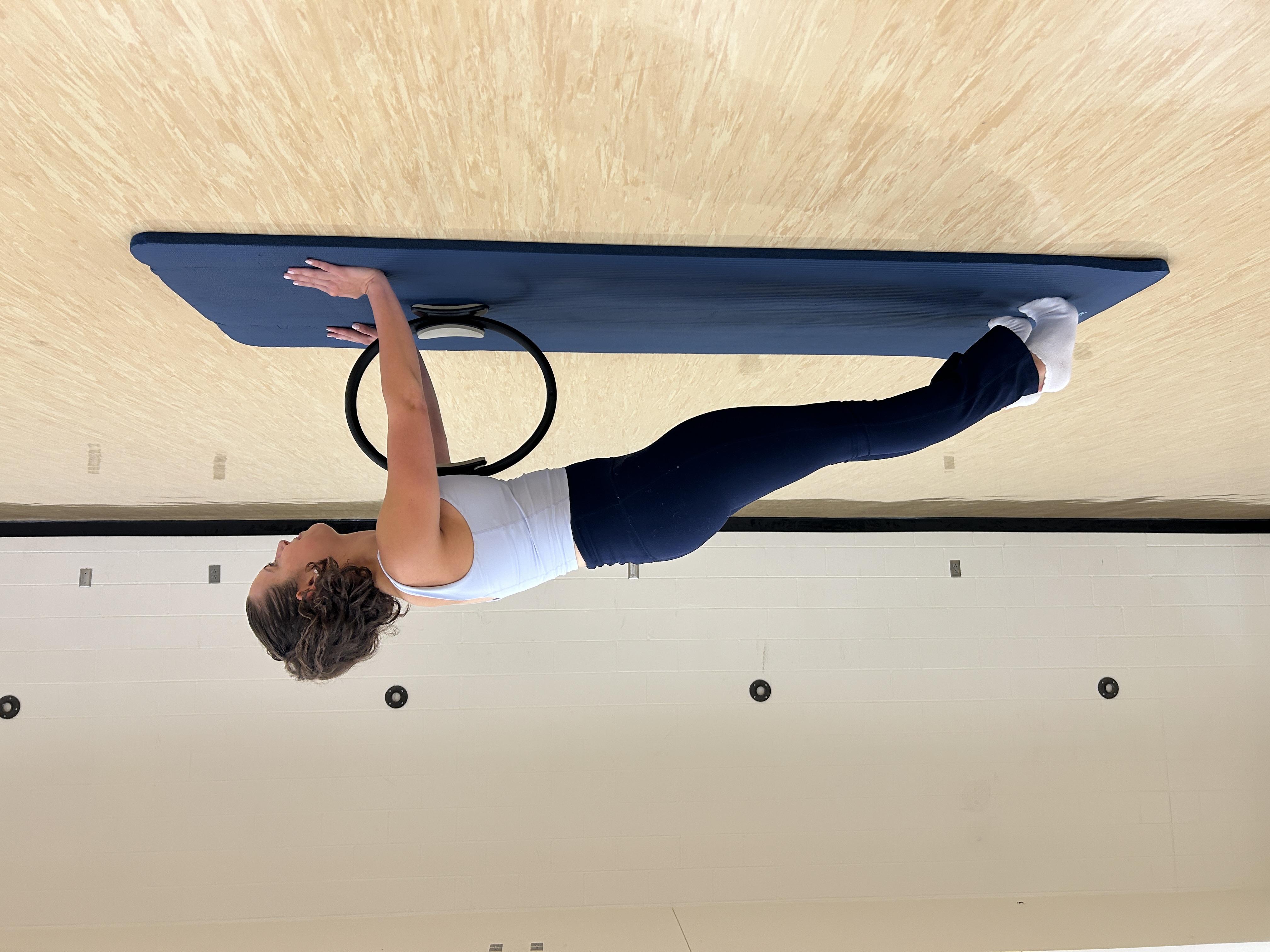
It is important to develop a sense of how a Push Up should feel as the demands placed on the body are considerable. We must maintain a plank position with the abdominals engaged, the head in alignment with the spine, and the upper arms tucked in close to the body as we lower ourselves to the mat and then press ourselves back to the starting position. Simple drills performed standing with no load on the body can help us understand elements like how to engage the Powerhouse and keep our upper arms from flaring out before adding the challenges of body weight to the exercise.
2. The Push Up and the Power of Exercise Regressions
Regressions, simply put, are a way of making an exercise or a movement easier to do. Regressions allow us to focus on proper technique and optimal alignment without having to worry about muscle fatigue, lack of strength, joint stresses, or involvement by unwanted muscles. Regressions help to build confidence as demands are increased. Regressions are critically important in Push Up training.
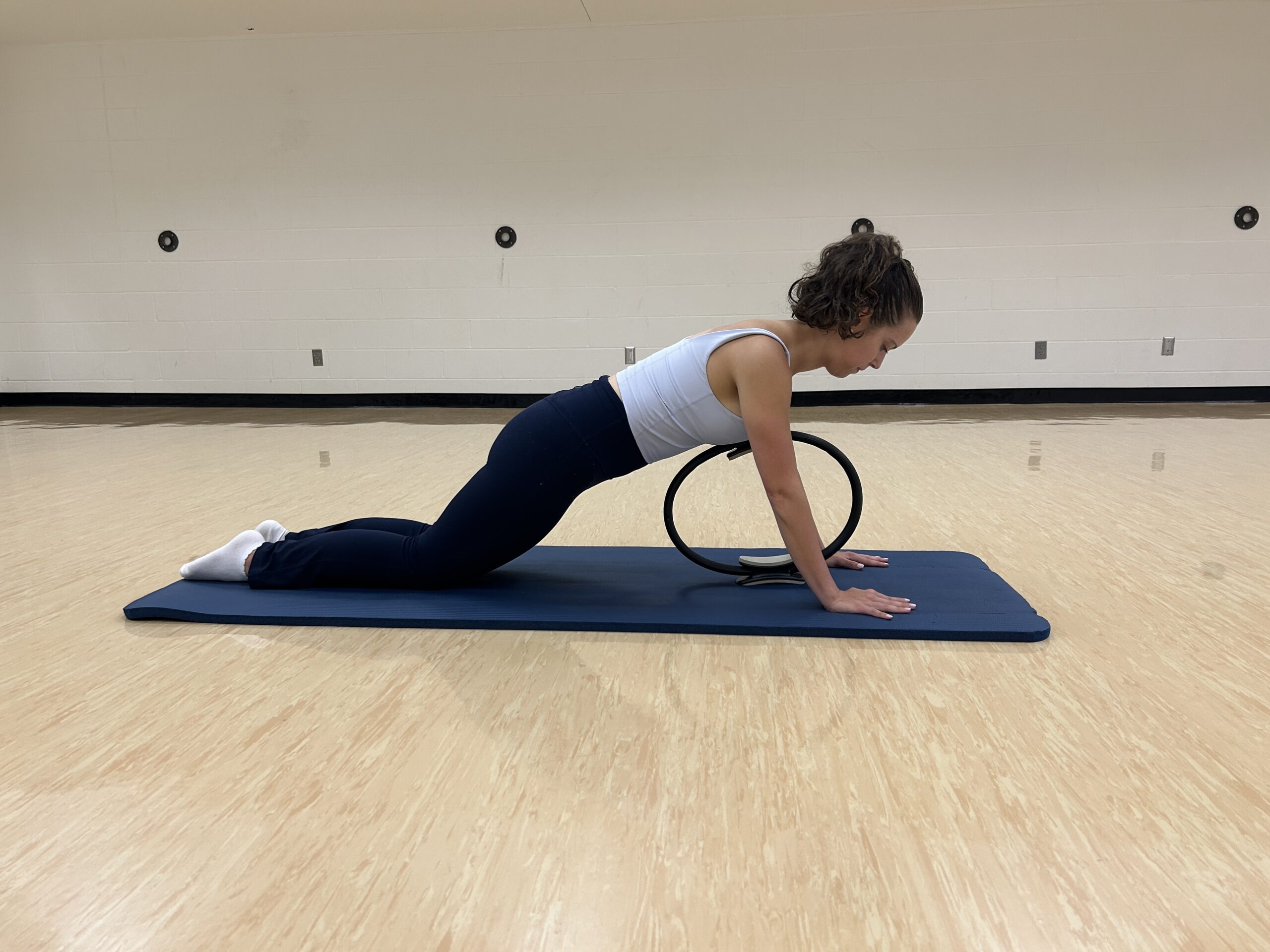
For Push Up, regressions involve shortening the length of the lever (that is, shortening the length of the body by placing the knees on the mat) and reducing the amplitude (how far we lower ourselves) so that less stress is placed on the shoulders as we develop our strength, technique, control, and confidence. The beauty of regressions is that we work on strength and technique gradually and simultaneously to help us reach our goal.
3. Wrist and Ankle Flexibility: The Overlooked Keys to a Great Push Up
Wrist and ankle flexibility are crucial in performing Push Up well. Our toes and our hands are where our bodies connect to the ground. Technically speaking, they are the end points of this closed-chain exercise. Appropriate wrist and ankle flexibility prevents pain in the wrists, forearms, and hands; reduces stress on the joints; provides proper weight distribution during movement; and allows us to execute the full range of motion of the exercise by optimally activating the muscles. In short, your Push Up will suffer if your wrists and ankles are not sufficiently flexible.
This three-pronged approach is effective. Semester after semester, students in my Pilates 101 course comment on how they were able to build strength and increase their confidence. One student, a gymnast who had been doing Push Ups for years, commented:
I’ve been doing push-ups literally my whole life, since I was little and in the gym almost every day. I’ve done or at least tried every version. … So when we started doing the basic Pilates push-up in class, I’ll admit I kind of brushed it off at first. But once I actually slowed down and focused on my form, keeping my elbows close, engaging my core, and controlling both the descent and the push-up, I realized I had been rushing through them for years. My technique improved so much just by being intentional and going back to that foundation. Now, … I feel stronger and more stable, especially through my core and shoulders.
Part 2 of this article delves into the specifics on how to use each of these components effectively by answering questions that include: Where do I begin? How do I make regressions work for me? And what are some of the ways I can increase my wrist and ankle flexibility? Utilizing simple props that are found in most Pilates studios, Part 2 will offer tips on how to make this important exercise less intimidating and ultimately achievable.
Special thanks to Sarah Roberson for demonstrating the exercises.

A triathlete who competed at national and international levels, Catherine began her classical Pilates journey after a running accident resulted in a total hip replacement. During her rehabilitation, she discovered the power of Pilates in helping her get back on her feet. In fact, in many ways, she was stronger than she was before her injury. She realized, “I would have been a much better athlete had I known about Pilates 20 years ago!” It was then that she decided to pursue teacher training so that she could work with others to help them achieve optimum strength, awareness of movement, and flexibility. She is passionate about spreading the word on how developing a regular practice in classical Pilates is a life-changing and life-long pursuit — and it can be embraced by everyone.
Catherine recently retired as a professor of Asian art history and associate dean of the Graduate School at The University of Alabama and now teaches part-time for the university’s department of kinesiology, where she offers classes in indoor cycling and Pilates for university credit. She is a graduate of Streamline Pilates’ 450-hour intermediate-level teacher training program. She has been a certified Spinning® instructor for 24 years and a certified Personal Trainer for the past 20 years. In addition, she holds a Ph.D. in East Asian Studies from the University of Toronto.