SHORT BOX : Side-To-Side –
by Sabrina Ellen Svard
June 13, 2018
~ From Wikipedia: Extrasensory perception, ESP, also called sixth sense, includes claimed reception of information not gained through the recognized physical senses but sensed with the mind.
As instructors, we know that Pilates is magical. But at first, Pilates is anything but magical. In fact, some of it is just plain crazy business! In order to feel the “magic” of Pilates, several fundamental exercises need to be learned to lay down the foundation for success. While I was thinking about Pilates “magic” and how crazy some of these exercises are, I knew I needed to figure out a way to teach them more successfully. This is when I came up a system called “Pilates ESP.”
Looking back to my first apparatus training, the teacher trainer just ran us through each exercise, quickly, one right after another, because time was of the essence. Many of the fundamental exercises made zero sense to us “newbies” (Elephant, Knee Stretches, Short Box, Stomach Massage, etc.) and left us feeling confused, frustrated and crying in the parking lot (seriously!). It has taken me years, and many more trainings, to grasp these fundamental exercises that are at the core (pun intended) of the Pilates system as well as how to teach them quickly and efficiently to “newbies.”
Let’s keep in mind that most clients come to us with no experience in doing Pilates. While we as instructors don’t want to overwhelm these “newbies” or scare them, or worse yet, bore them, we still have to teach them some pretty damn crazy exercises! And we want to get them hooked straight away – like we are – and to continue their never-ending Pilates journey!
PILATES ESP… A System For Successful Teaching
When teaching newbies the fundamentals, less is more – less correcting, less cueing, less talking, and less perfection; we need to let them move! Remember, our job is to GET THEM MOVING and GET IT DONE, not make them feel like every move they make is wrong (even if it is at first!). They need to move so we as instructors can see what is happening in their bodies and so they get a workout!
In Pilates, the instruction (as well as the movements) should both be done in the most efficient way possible. As I thought about how to teach newbies in the most efficient way possible, I came up with a simple system for success. This method can be used to teach any exercise, but in this series, I will use it on the fundamentals. Allow me to introduce you to my less-is-more teaching methodology I created called Pilates ESP.
- Exercise – state the name of the exercise.
- Set Up – tell them the apparatus set up for the “ideal” form of the exercise.
- Points – give the three (THREE not 23!) most important points to execute the exercise.
Then GET THEM MOVING!!!
This simple system will get your newbie in motion and then you can really evaluate what is going on with the body in front of you. The next challenge will be for you to be QUIET and just watch this newbie move and ponder:
- What happens when this person moves?
- Does this body in front of you need any changes to the ideal?
- What would help make the execution be more successful, e.g. a prop or a modification?
- What if this person just needs more practice and that is all?
Make any adjustments in motion and GET IT DONE! Then move on to the next exercise.
The magic of Pilates is that over time the body will connect the dots and the fine tuning will begin, often on its own. But at first, we need to let our students just move and learn the rote movement patterns.
And to illustrate how the less-is-more approach of Pilates ESP works, here is the first exercise in my series of successfully teaching the fundamentals.
SHORT BOX: SIDE TO SIDE
Set Up: All springs, sitting on sits bones on top of the short box, feet under strap, strap is tight with legs pushing out activating the abductors, collar bones in front of hip bones, ribs lifting out of the hips, arms up holding short box pole.
Points: 1. Keep your seat grounded. 2. Lean your torso slightly to the diagonal corner of the footbar. 3. Lengthen your torso on both sides while keeping the pelvis and legs still.

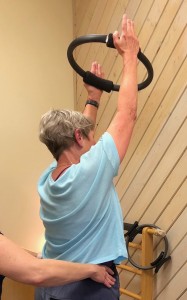 How to teach differentiation: This we have done standing – I am holding the iliac crest and keeping the pelvis still as my client lifts up and out on the diagonal.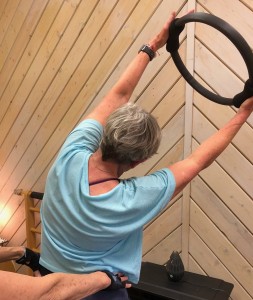
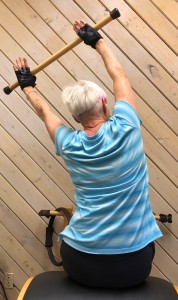
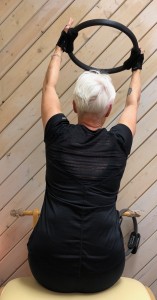
A great example of adding lateral flexion to Side to Side – both sides of the torso are lifted and long with slight lateral flexion to the left. Keep the seat grounded especially on the right. This feels great!!!
Many thanks to my fabulous clients for volunteering their “sides” for this article!!
Please join Sabrina’s Facebook group!
UNPOLICED PILATES PERSPECTIVES – Variations – Successes – Cues
Please join, but more importantly, PLEASE SHARE your perspective on the page!!! Share without fear. I’m there to protect you! Look for more details coming soon! And please friend me on Facebook: Sabrina Ellen Svard.